
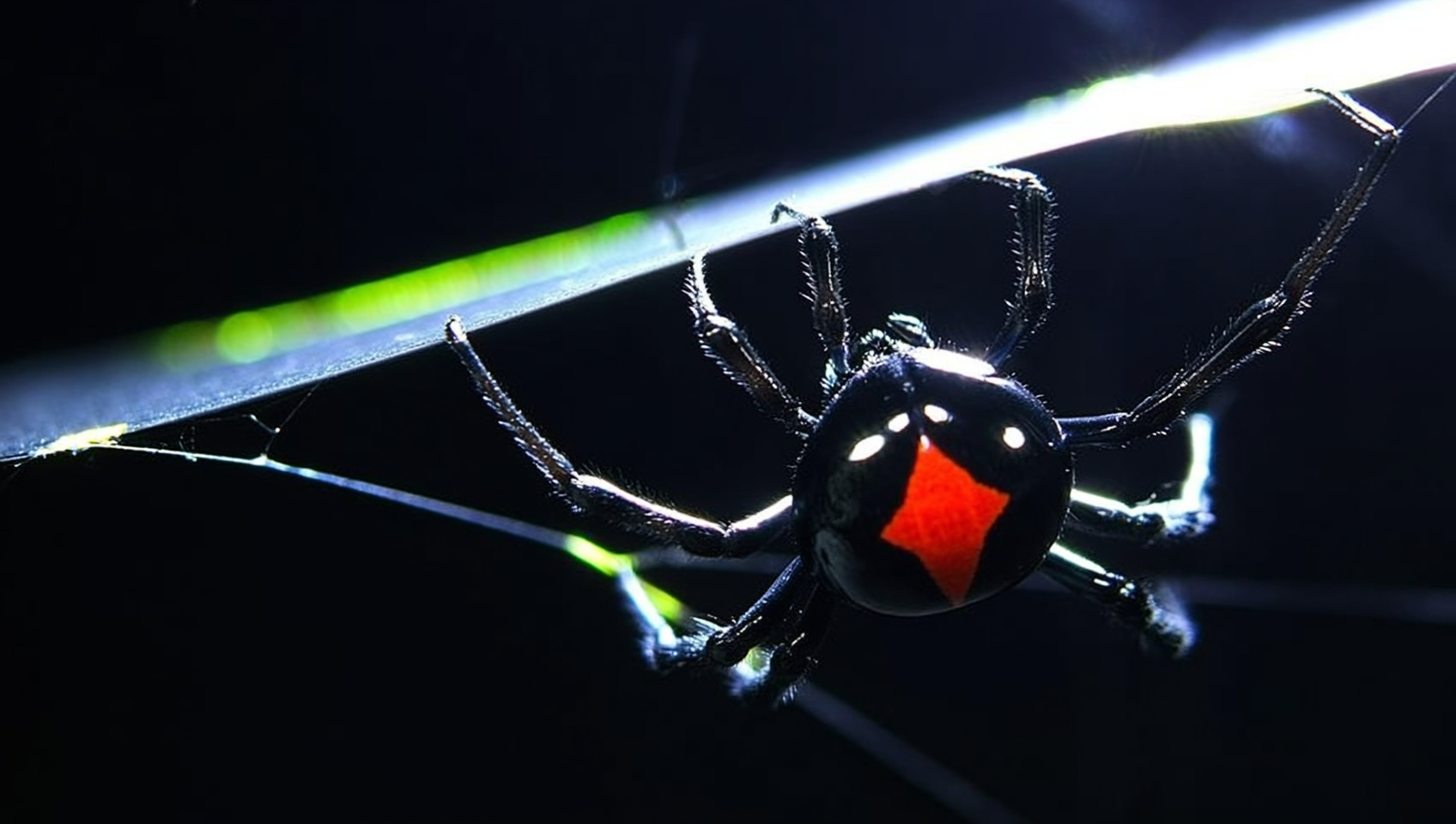
The Western black widow (Latrodectus hesperus) is established across southern Idaho including Boise, Meridian, Nampa, and Eagle. Adults have a glossy black body with a red hourglass under the abdomen. If bitten, call Idaho Poison Center at 1-800-222-1222 immediately and Boise Bug Bombers at (208) 918-2597.
SPECIES · IDAHO · MEDICALLY SIGNIFICANT
The black widow spider in Idaho.
What it looks like. What to do if you find one. What to do if you’ve been bitten.
The Western black widow (Latrodectus hesperus) is established throughout southern Idaho including Boise, Meridian, Nampa, and Eagle. The female is glossy black with a red hourglass-shaped marking on the underside of her abdomen; she is the spider that bites and is medically significant. The male is smaller, browner, rarely bites, and is not medically significant. Bites are rarely fatal in healthy adults but require professional medical evaluation. If you’ve been bitten, call the Idaho Poison Center at 1-800-222-1222 immediately.
Are black widow spiders in Idaho?
A black widow is identified by three features: a glossy black, smoothly rounded body about 0.5 inches long (1.5 inches with legs extended for adult females); a bright red, hourglass-shaped marking on the underside of the abdomen; and a tangled, irregular web, not a geometric orb shape, typically built low to the ground in a dark, undisturbed harborage zone.
What the female looks like
- Body color: glossy black, smooth, no hair or noticeable texture
- Body shape: rounded abdomen, distinctively bulbous
- Size: approximately 0.5 inches (12mm) body length; 1.5 inches (38mm) with legs extended
- Underside marking: bright red hourglass (sometimes broken into two triangles, occasionally orange in juveniles)
- Top-side marking: may show two small red dots near the front of the abdomen; otherwise solid black
- Legs: long, thin, often held in a defensive posture when the spider is disturbed
What the male looks like
- Body color: brown to grey, often with light stripes
- Body shape: narrower, less bulbous than the female
- Size: about half the female’s size
- Bite risk: very low; males rarely bite and the venom is much less potent
What the web looks like
Black widow webs are tangled and irregular, explicitly not the geometric circular orb shape associated with garden spiders. The web is messy, three-dimensional, and built low to the ground. Touch a black widow web and the strands are noticeably stronger than other spider silk, this is one of the field-ID markers Idaho pest applicators use before they spot the spider itself.
What an egg sac looks like
Spherical, papery, cream-to-tan colored, about the size of a grape (0.5 inch / 12mm). Each sac contains 100-400 eggs. A black widow female anchors egg sacs in the deepest part of the harborage, this is why “spray the spider you see” treatment fails: the egg sacs persist and the population rebuilds in 4-8 weeks.
In Treasure Valley homes, black widows are found in crawl spaces, garage corners, basement window wells, exterior stairwells, irrigation valve boxes, woodpiles, and outbuildings. They prefer dark, undisturbed harborage zones with access to ground-level insect traffic. They are rarely found in upper-floor living areas; finding one in a kitchen or upstairs bathroom is unusual and typically means the spider has been transported in stored items.
The seven Idaho harborage zones to check
- Crawl space. Particularly the corners and the joist-rim junctions. Common in Winstead Park, North End, and Bench Boise homes; common in Settlers-Park-adjacent Meridian properties.
- Garage corners. Especially detached garages with infrequent foot traffic. Behind stored boxes, in rafters above the door tracks.
- Basement window wells. Both interior corners and exterior wells if not sealed.
- Exterior stairwells. Stairs into a basement entry, particularly if leaves and debris accumulate.
- Irrigation valve boxes. Common in Treasure Valley landscaping; dark, undisturbed, near insect activity.
- Woodpiles. Black widows colonize woodpiles fast. Stack at least 20 feet from the house if possible.
- Outbuildings. Sheds, detached workshops, pool houses, the same conditions as detached garages.
If you find a black widow in or near your home, do not attempt to kill or capture it without protection. Do not destroy the egg sac with consumer pesticide, fragmented sacs can release viable spiderlings. Photograph the spider, web, and any egg sacs, then call a licensed pest control applicator for harborage-targeted treatment. If a person, child, or pet has been bitten, call the Idaho Poison Center at 1-800-222-1222 immediately and seek medical evaluation.
Don’t
- Don’t try to vacuum the spider. Vacuum bags retain live spiders and viable egg sacs.
- Don’t spray the spider with a consumer aerosol. A reactive shot doesn’t touch the harborage and may scatter spiderlings.
- Don’t destroy the egg sac with a stick or broom. Fragmented sacs release spiderlings into the same harborage.
- Don’t put a hand into an unlit crawl space, woodpile, or stored-box stack. Use a light. Black widows do not chase, but they do bite when pressed.
Do
- Photograph the spider, web, and any egg sacs. This helps the pest applicator confirm species and locate the harborage on arrival.
- Note the location precisely. “Front-left corner of the crawl space, behind the foundation vent” beats “in the crawl space.”
- Restrict access to the harborage zone if possible, particularly important if children or pets use the area.
- Call a licensed Idaho applicator for harborage-targeted treatment. Generic spider sprays fail because the egg sacs persist.
Treatment: Boise → · Meridian → · Nampa → · Eagle →
If you have been bitten by a confirmed or suspected black widow, call the Idaho Poison Center at 1-800-222-1222 immediately, then seek medical evaluation. Per CDC NIOSH guidance, black widow bites are rarely fatal in healthy adults but produce severe systemic symptoms (muscle cramps, abdominal pain, hypertension) within 30-60 minutes and require professional assessment, especially in children, older adults, the immunocompromised, and pregnant patients.
Symptoms to watch for
- Local: pinprick sensation at the bite site, two small red puncture marks, mild local swelling
- Within 30-60 minutes: muscle cramps (often starting at the bite site and spreading), abdominal rigidity, sweating, headache
- More severe: elevated blood pressure, rapid heart rate, nausea, restlessness, anxiety
- Pediatric / elderly / immunocompromised: symptoms can be more severe and develop faster, treat as an emergency
First aid
- Call Idaho Poison Center 1-800-222-1222 before driving anywhere if symptoms are mild, they will route you correctly.
- Wash the bite area gently with soap and water.
- Apply a cool compress to the bite site to reduce pain and swelling.
- Do not apply ice directly to skin for prolonged periods.
- Do not attempt to “suck out” venom or apply tourniquets, these methods are ineffective and may cause additional harm.
- Seek medical evaluation especially if the patient is a child, elderly, pregnant, immunocompromised, or showing systemic symptoms.
Prevention is harborage reduction: seal entry points to crawl spaces and garages, keep woodpiles at least 20 feet from the house, use lighting in storage areas, declutter detached outbuildings, and treat irrigation boxes and exterior stairwells on a quarterly schedule. Most Treasure Valley black widow infestations are harborage-driven; reduce harborage and the population drops.
Quarterly prevention actions
- Inspect and seal crawl space access points; install or replace foundation vent screens
- Move woodpiles, mulch piles, and stored landscaping materials at least 20 feet from the house
- Install LED lighting in detached garages and outbuildings (black widows avoid lit spaces)
- Declutter stored boxes; stack at least 6 inches off the floor and away from walls
- Treat or replace irrigation valve box covers if they sit in mature landscaping
- Schedule a professional quarterly perimeter treatment
- Boise spider control →
- Meridian spider control →
- Nampa spider control →
- Eagle spider control →
- All spider services →
Found one? Don’t spray it. Call.
- Schedule spider treatment →
- Or call (208) 918-2597
- PubMed: Latrodectus mactans Bite Clinical Presentation
- NIH NIAID: Venom Research and Antivenom Resources
- OSHA: Workplace Spider Bite First Aid Resources
Idaho State Department of Agriculture (ISDA)-licensed Idaho applicator · 100% satisfaction warranty · Kid + pet safe once dry
Frequently Asked Questions
Q1: Are there black widow spiders in Idaho?
Yes. The Western black widow (Latrodectus hesperus) is established throughout southern Idaho including Boise, Meridian, Nampa, Eagle, and the broader Treasure Valley. Black widows are most commonly found in crawl spaces, garage corners, basement window wells, exterior stairwells, irrigation boxes, and woodpiles.
Q2: How do you identify a black widow spider?
A black widow is identified by three features: a glossy black, smoothly rounded body about 0.5 inches long; a bright red hourglass-shaped marking on the underside of the female’s abdomen; and a tangled, irregular web, not a geometric orb shape, typically built low to the ground in a dark, undisturbed harborage zone.
Q3: What should I do if I’ve been bitten by a black widow?
Call the Idaho Poison Center at 1-800-222-1222 immediately, then seek medical evaluation. Per CDC NIOSH guidance, black widow bites are rarely fatal in healthy adults but produce severe systemic symptoms within 30-60 minutes and require professional assessment, especially in children, older adults, the immunocompromised, and pregnant patients.
Q4: Are black widow bites fatal?
Black widow bites are rarely fatal in healthy adults but are medically significant and require professional medical evaluation. CDC NIOSH classifies the black widow as a venomous spider of public health concern. Risk is elevated in children, older adults, immunocompromised patients, and pregnant patients, these populations should be treated as emergencies.
Q5: How do you get rid of black widow spiders?
Harborage-targeted treatment by a licensed Idaho applicator is the most effective method. Generic spider sprays fail because the female’s egg sacs persist in harborage zones and the population rebuilds in 4-8 weeks. Effective treatment includes inspection of crawl spaces, garage corners, irrigation boxes, and exterior stairwells; targeted residual application to harborage; and quarterly follow-up to break the breeding cycle.
Q6: What should I do if I find a black widow in my Boise home?
Do not crush it without protective gear. Call Boise Bug Bombers at (208) 918-2597 for same-day identification and harborage treatment, and if anyone has been bitten, call the Idaho Poison Center at 1-800-222-1222 immediately. Document the spider’s location for the technician.
Q7: How can I tell a black widow from a false widow in Idaho?
The Western black widow (Latrodectus hesperus), established in Idaho, has a glossy jet-black body with a distinct red hourglass on the underside of the abdomen. False widow species in the region (e.g., Steatoda) have brown-and-cream markings, no hourglass, and a smaller, less symmetrical body shape.
Q8: Where do black widows hide on Boise properties?
Black widows in Boise hide in undisturbed crawl spaces, garage corners and rafters, basement window wells, exterior stairwells, woodpiles, irrigation boxes, and storage sheds. They build messy three-dimensional webs near ground level. Boise Bug Bombers maps all harborage zones during a property walk.
Sources
Authoritative references for the information on this page. All third-party links open in a new tab.