
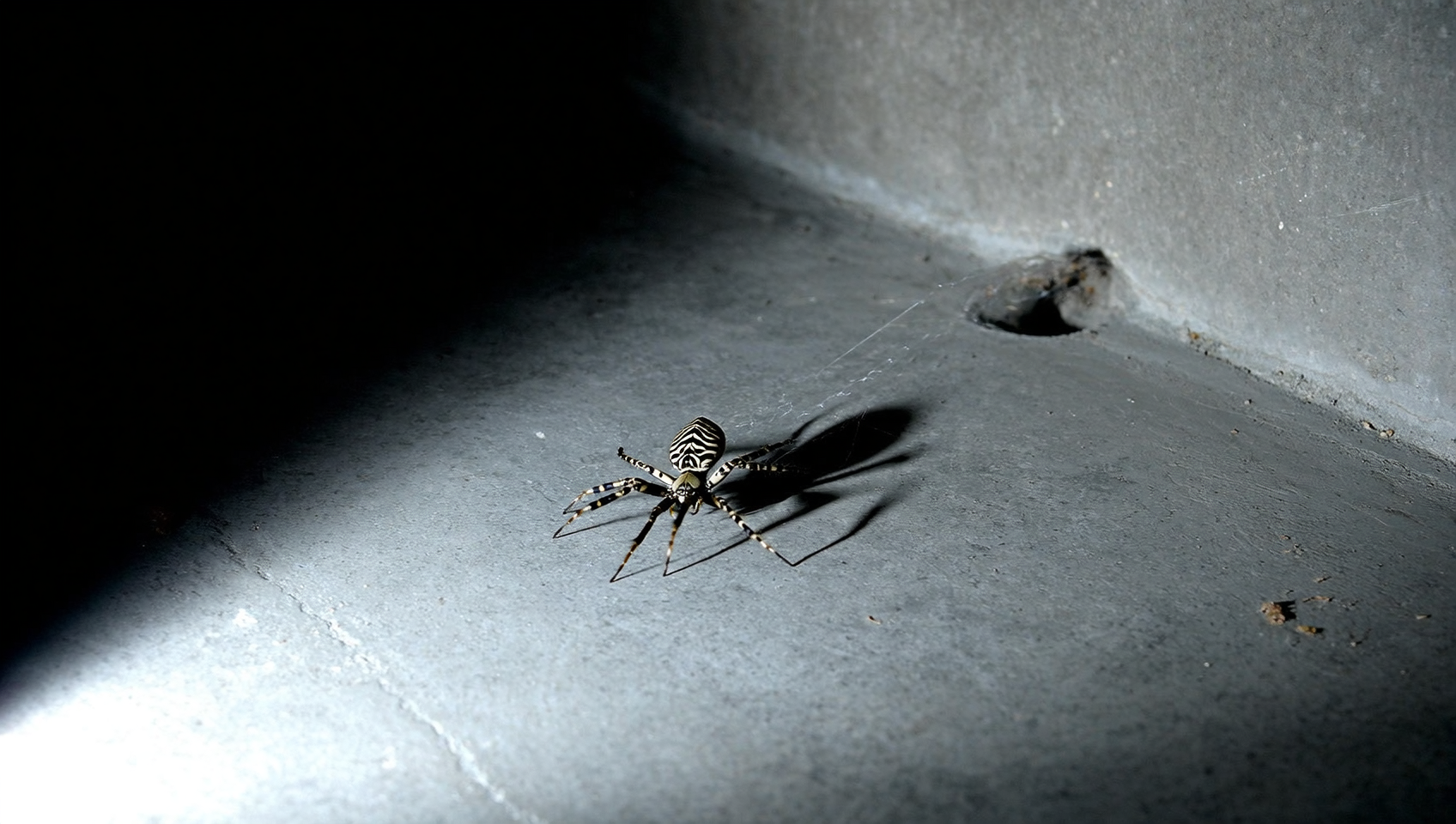
SPECIES · IDAHO · COMMON IN BASEMENTS + CRAWL SPACES
The hobo spider in Idaho.
What it looks like. Why the bite story has changed. What to do if you find one.
The hobo spider (Eratigena agrestis) is established throughout the Pacific Northwest, and Idaho, particularly the Treasure Valley, is part of its core range. It is a fast-running, funnel-web-building spider commonly found in basements, crawl spaces, garages, and ground-level harborage. Recent research has downgraded the medical significance of its bite: the CDC removed the hobo spider from its venomous spider list in 2017, and current peer-reviewed evidence does not support the older claim of necrotic lesions in healthy adults. Bites can still produce localized pain, redness, and swelling and should be evaluated if symptoms develop or persist. If you’ve been bitten and are symptomatic, call the Idaho Poison Center at 1-800-222-1222.
A hobo spider is identified by five features: a light-to-medium brown body about 0.4-0.6 inches long (with leg span up to 1.5 inches); a distinctive herringbone or chevron pattern on the dorsal abdomen pointing toward the head; long, unmarked legs that lack the dark banding seen on similar funnel-web spiders; a flat, funnel-shaped web with the spider waiting at the narrow end; and ground-level harborage in basements, garages, or crawl spaces. Hobo spiders are fast, exceptionally fast for a spider this size, and that running speed is a primary field-ID marker.
What the body looks like
- Body color: light brown to medium brown, sometimes with a slight grey or tan cast
- Body shape: elongated abdomen, no glossy sheen, no metallic markings
- Size: approximately 0.4-0.6 inches (10-15mm) body length; up to 1.5 inches (38mm) leg span
- Dorsal pattern: distinctive herringbone or chevron pattern on the top of the abdomen, pointing forward toward the cephalothorax, this is the single best ID marker for distinguishing hobos from giant house spiders
- Legs: long, thin, unmarked, no dark rings or bands; legs that show banding indicate a giant house spider (Eratigena atrica), not a hobo
- Eyes: eight eyes in two rows of four; not relevant for casual ID but the standard taxonomic feature
What the web looks like
Hobo spider webs are funnel-shaped, explicitly not the geometric circular orb shape of garden spiders, and explicitly not the tangled, irregular web of the black widow. The web is a flat sheet with a narrow tunnel at one end where the spider waits. When prey hits the sheet, the hobo charges out of the funnel at extraordinary speed to grab it. Funnel webs are typically built in:
- The corners of basements, crawl spaces, and garages
- Behind stored boxes, tools, and stacked materials
- In window wells and exterior foundation cracks
- Along the base of walls in cluttered ground-level rooms
- In dense ground-level vegetation along the foundation perimeter
Hobo spider vs. giant house spider
These two species are visually similar and frequently confused. The giant house spider (Eratigena atrica) is now more common in Pacific Northwest homes than the hobo, and is genuinely harmless. Distinguishing them matters because the giant house spider is also the hobo’s primary natural competitor, its presence reduces hobo populations.
- Hobo: legs unmarked, herringbone pattern on abdomen, body 0.4-0.6 inches, slightly smaller overall
- Giant house spider: legs visibly banded with darker rings, similar abdominal pattern but with darker markings, body up to 0.7 inches, noticeably larger and bulkier
When in doubt, photograph the spider and let a licensed Idaho applicator confirm. The University of Idaho Extension and Washington State University Extension both publish identification keys.
Hobo spider vs. brown recluse, important
The brown recluse (Loxosceles reclusa) is not native to Idaho and is not established here. Brown recluse populations are confined to the south-central and south-eastern United States, well outside Idaho’s range. If a clinician or pest report references a “brown recluse bite” in Idaho, the species identification is almost certainly wrong. The University of California Riverside Department of Entomology, the leading academic authority on Loxosceles distribution, has documented this extensively: the brown recluse range stops far short of the Pacific Northwest.
In Treasure Valley homes, hobo spiders are found at ground level, basements, crawl spaces, garages, utility rooms, window wells, and foundation perimeters. They are rarely found above the first floor; a hobo spider in a second-story bedroom typically arrived through stored items or by being carried. They prefer dark, cluttered, low-traffic harborage with insect activity, and their populations peak in late summer and early fall when males wander in search of mates.
The six Idaho harborage zones to check
- Basement corners. Particularly behind stored boxes, against unfinished concrete walls, in utility rooms. Common in Boise’s older North End and Bench homes with daylight basements.
- Crawl spaces. Joist-rim junctions, foundation vents, behind insulation. Common in Winstead Park ranch homes and Meridian properties with vented crawl spaces.
- Garage clutter. Behind stacked boxes, against the wall behind tool benches, in seldom-moved storage areas. Detached garages have higher populations than attached.
- Window wells. Exterior wells with debris accumulation, particularly in basements with grade-level egress windows.
- Foundation perimeter vegetation. Dense ground cover, low shrubs touching the foundation, mulch beds with high moisture.
- Sheds and outbuildings. The same conditions as detached garages, dark, cluttered, infrequent traffic, ground-level insect activity.
Seasonal pattern
- April-June: hobo populations build slowly as overwintered juveniles mature
- July-August: mature females settle into permanent funnel webs in harborage
- September-October: peak observation period, adult males wander widely in search of mates, and this is when most residents first see them. A hobo spider running across the basement floor in October is doing exactly what hobo spiders do in October.
- November-March: populations drop sharply with cold; surviving spiders remain in protected harborage
The medical significance of the hobo spider bite has been substantially downgraded. The CDC removed the hobo spider from its venomous spider list in 2017 after multiple peer-reviewed reviews, including work by University of California Riverside entomologist Rick Vetter, found that the original 1980s “necrotic bite” claims were not supported by controlled evidence. The current scientific consensus is that hobo spider bites are typically benign in healthy adults and that previously-attributed necrotic wounds were most often caused by other conditions (MRSA infection, brown recluse misidentification, or unrelated skin pathology). Bites can still cause local redness, swelling, and discomfort and should be evaluated if symptoms develop, persist, or worsen.
What hobo spiders are not
- Not on the CDC’s current venomous spider list. This is the most consequential authority shift of the last decade in hobo spider literature.
- Not the cause of necrotic lesions in current peer-reviewed evidence. The 1987 case series that originated this claim has not been replicated under controlled conditions and has been formally retracted as a clinical indication by multiple toxicology bodies.
- Not aggressive. Hobos run when disturbed, including running at humans, but the running is escape behavior, not attack. Bites occur when the spider is pressed against skin, typically inside clothing, bedding, or shoes that have been worn over harborage.
What to do if you’ve been bitten
- Wash the bite area gently with soap and water.
- Apply a cool compress to reduce local pain and swelling.
- Monitor the bite site. A typical hobo bite produces local redness and mild swelling that resolves over several days.
- Seek medical evaluation if symptoms are severe at onset, persist beyond 72 hours, worsen progressively, show signs of infection (expanding redness, warmth, pus, fever), or if the patient is a child, elderly, or immunocompromised.
- Call the Idaho Poison Center at 1-800-222-1222 for guidance if symptoms are systemic or if you are uncertain whether to seek care.
The Idaho Poison Center routes Idaho callers to medical professionals who can assess the specific bite presentation. They are the correct first call when symptomatic, better than a web search and better than waiting it out alone.
If you find a hobo spider in your home, photograph it for ID confirmation, capture it under a glass if you want a definitive identification by a licensed applicator, and reduce harborage in the area where you found it. Hobo spiders are not aggressive but they are fast, do not handle one barehanded. If you find multiple hobos in the same season, that indicates established harborage and warrants a professional quarterly perimeter treatment to break the funnel-web population.
Don’t
- Don’t try to grab a hobo with bare hands. They run fast and bites occur from pressing the spider against skin.
- Don’t spray the spider with a consumer aerosol. Reactive sprays do not touch the funnel-web population and have no effect on the next generation.
- Don’t ignore multiple sightings. One hobo is a single spider. Five hobos in a season is a harborage problem.
Do
- Photograph the spider. Top-down shot showing the dorsal pattern is the best ID image. A licensed applicator can confirm species from a clear photo.
- Capture it under a glass if you want a physical specimen for identification, slide a card under the glass and lift.
- Reduce harborage: declutter the basement or garage, seal foundation cracks, remove cardboard and stored boxes from ground contact, install LED lighting in dim corners.
- Schedule a professional perimeter treatment if you have multiple sightings, an unfinished basement, or a vented crawl space with insect activity.
Treatment: Boise → · Meridian → · Nampa → · Eagle →
Hobo spider prevention is harborage reduction plus exclusion: seal foundation cracks and crawl space vents, declutter ground-level storage, install lighting in basements and garages, trim foundation perimeter vegetation, and treat the exterior perimeter on a quarterly schedule. Hobos thrive in dark, cluttered, ground-level harborage; the more of that you remove, the smaller the population.
Quarterly prevention actions
- Declutter basement, crawl space, and garage, particularly cardboard and ground-contact storage
- Seal foundation cracks, crawl space vents, and gaps around utility penetrations
- Install LED lighting in basements, garages, and utility rooms
- Trim foundation perimeter vegetation; pull mulch and ground cover back 12-18 inches from the foundation
- Repair window screens, particularly in window wells and basement egress
- Schedule a professional quarterly perimeter treatment (April, July, October, January)
- Boise spider control →
- Meridian spider control →
- Nampa spider control →
- Eagle spider control →
- All spider services →
Found a fast one in the basement? Photograph it. Then call.
Idaho State Department of Agriculture (ISDA)-licensed Idaho applicator · 100% satisfaction warranty · Kid + pet safe once dry
Frequently Asked Questions
Q1: Are there hobo spiders in Idaho?
Yes. The hobo spider (Eratigena agrestis) is established throughout the Pacific Northwest, and Idaho, particularly the Treasure Valley including Boise, Meridian, Nampa, and Eagle, is part of its core range. Hobo spiders are most commonly found at ground level: basements, crawl spaces, garages, window wells, and along foundation perimeters.
Q2: How do you identify a hobo spider?
A hobo spider is light-to-medium brown, about 0.4-0.6 inches long, with a distinctive herringbone or chevron pattern on the dorsal abdomen pointing forward, long unmarked legs without dark banding, and a flat funnel-shaped web with the spider waiting at the narrow end. Hobos are also exceptionally fast runners, running speed is one of the primary field-ID markers.
Q3: Are hobo spider bites dangerous?
The medical significance of the hobo spider bite has been substantially downgraded. The CDC removed the hobo spider from its venomous spider list in 2017 after peer-reviewed evidence did not support the original necrotic-bite claims. Current consensus is that bites are typically benign in healthy adults, producing local redness and swelling. Seek medical evaluation if symptoms are severe, persist beyond 72 hours, or show signs of infection.
Q4: What is the difference between a hobo spider and a brown recluse?
The brown recluse is not native to Idaho, its range is confined to the south-central and south-eastern United States. If a bite in Idaho has been attributed to a brown recluse, the species identification is almost certainly wrong. The hobo spider is the Pacific Northwest funnel-web species commonly mistaken for the recluse; the two look different and live in different parts of the country.
Q5: How do you get rid of hobo spiders?
Hobo spider control is harborage reduction plus exclusion plus quarterly perimeter treatment. Declutter ground-level storage, seal foundation cracks and crawl space vents, install lighting in basements and garages, trim foundation perimeter vegetation, and schedule a professional quarterly treatment. Reactive sprays on individual spiders do not affect the funnel-web population; harborage-targeted treatment is required to reduce sightings.