
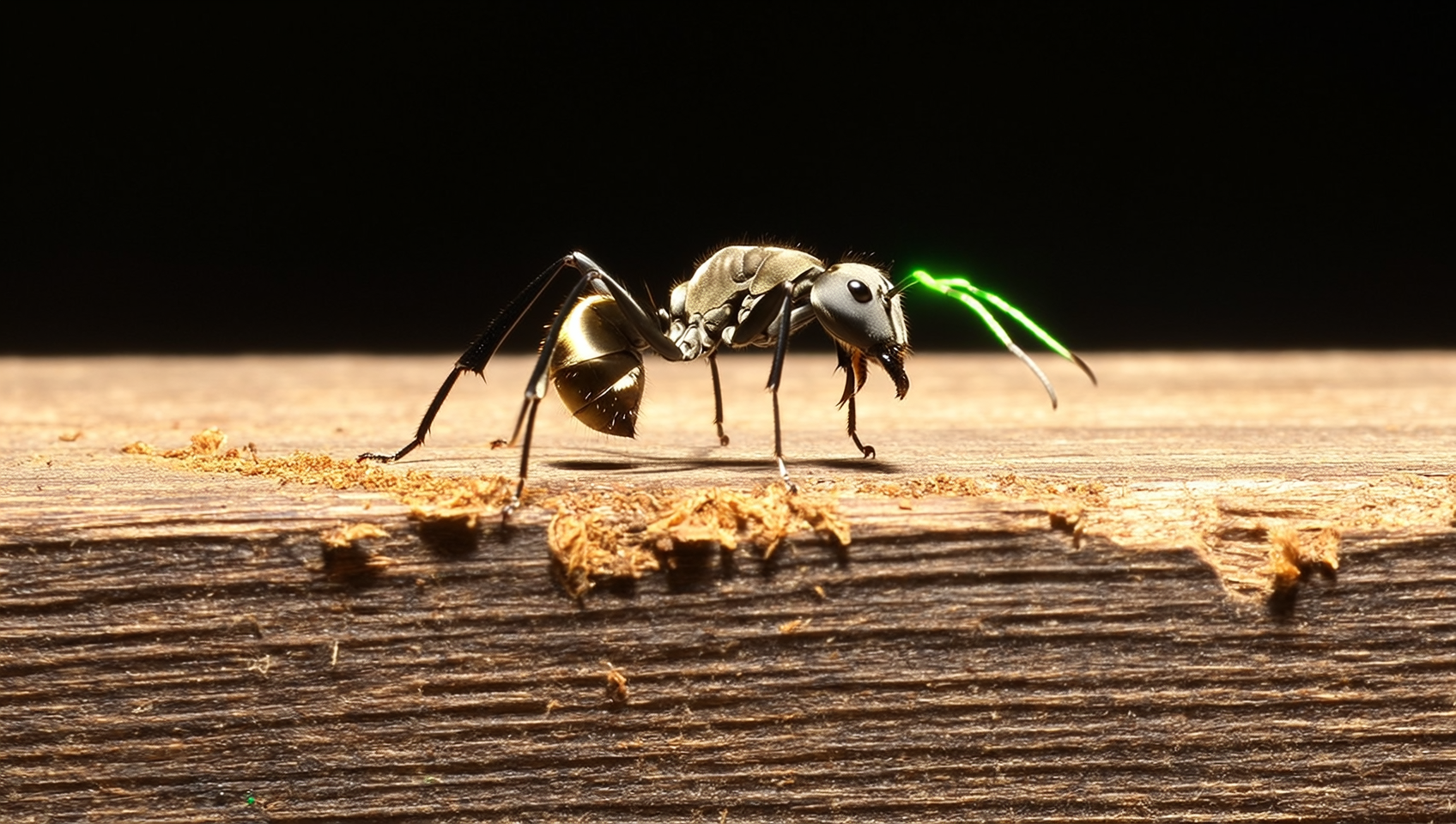
SPECIES · IDAHO · FRAMING DAMAGE · STRUCTURAL PEST
Carpenter ants in Idaho.
The framing-damage species. How to identify them. Why this isn’t a termite problem (but it is a structural one).
Carpenter ants, primarily the western black carpenter ant (Camponotus modoc) in the Treasure Valley, are large black ants that excavate galleries in wood to build nests. Unlike termites, carpenter ants do not eat the wood they tunnel through; they remove it as small fibrous shavings called frass. They prefer moisture-damaged wood, which means a carpenter ant problem is usually also a moisture problem in framing, siding, deck structure, or roof penetrations. Idaho’s relatively dry climate makes termites a low priority but carpenter ants a genuine structural concern, particularly in homes with chronic moisture intrusion or aging siding and trim.
A carpenter ant is identified by four features: size, carpenter ants are large (workers 1/4-1/2 inch; queens up to 5/8 inch), substantially bigger than the small ants typically seen in a kitchen; color, most Treasure Valley carpenter ants are uniformly black, sometimes with a red-brown thorax; a single node (waist segment) between thorax and abdomen, with a smoothly evenly rounded thorax in profile; and a habit of foraging at night, often along structural lines like siding edges, deck rim joists, and roof eaves.
What the worker looks like
- Body color: uniformly black, sometimes with a reddish-brown thorax (Camponotus modoc variant common in Idaho)
- Body size: workers vary 1/4 to 1/2 inch (6-13mm); polymorphic, same colony produces small and large workers
- Body shape: single node between thorax and abdomen (acrobat ants and many other species have two nodes, this is the single best ID marker for distinguishing carpenter ants from common Idaho confusables)
- Thorax profile: smoothly evenly rounded when viewed from the side (other large ants often have an uneven dorsum)
- Antennae: elbowed, with 12 segments
- Behavior: primarily nocturnal foragers; daytime trails of large black ants on a deck or siding are a strong indicator
What the swarmer (winged reproductive) looks like
- Color: black with smoky-tinted wings
- Size: about 5/8 inch including wings
- Timing: swarms emerge May-July in Idaho; indoor swarmer sightings indicate an established interior colony
- Why this matters: finding swarmers inside the home in spring is the diagnostic signal that the colony is mature and inside the structure, not just foraging in from outside
What the damage looks like
Carpenter ant damage in wood is smooth and clean, they excavate galleries with chiseled, sanded edges, almost as if a fine carpenter shaped the void. The galleries follow the wood grain when convenient but cross it when needed. Inside an active gallery you find live ants, eggs, and larvae. Outside the gallery you find frass, small fibrous shavings of wood, sawdust mixed with bits of insect parts and dirt, accumulated below an entry hole.
Carpenter ants and termites are confused frequently and behave completely differently. Carpenter ant galleries are smooth and clean, with frass (sawdust shavings) accumulated below an entry hole; ants are visible inside and outside the gallery. Termite galleries are packed with mud, contain no clean shavings, and the insects look entirely different, termites are pale, soft-bodied, with broad waists (no node between thorax and abdomen) and equal-length wings. In Idaho’s dry climate termites are uncommon; in a Treasure Valley home, wood damage is far more likely to be carpenter ant than termite.
The five-feature comparison
| Feature | Carpenter ant | Termite |
|---|---|---|
| Body color | Black or black-red | Pale cream to light brown |
| Body shape | Distinct waist (one node) | Broad continuous waist (no node) |
| Antennae | Elbowed | Straight, bead-like |
| Wings (swarmer) | Front wings longer than rear | Front and rear wings equal length |
| Damage signature | Clean smooth galleries + frass below entry | Mud-packed galleries, no clean shavings |
| Idaho prevalence | Common | Uncommon (dry climate) |
Why Idaho is a carpenter ant state, not a termite state
The Treasure Valley’s relatively dry climate is hostile to subterranean termite establishment, termites need consistent soil moisture to maintain their tubes and colonies. Carpenter ants, by contrast, exploit the localized moisture damage that does occur in Idaho homes: aging caulk around windows, deck ledger boards with moisture intrusion, roof penetration leaks, dishwasher and washing machine leaks into wall framing, and exterior siding gaps that admit moisture. Idaho framing damage attributed to termites is almost always carpenter ants on closer inspection.
Carpenter ants nest in moisture-compromised wood. The most common Idaho home locations are deck ledger boards and rim joists, wall framing around windows with failed caulk, the roof structure around chimney flashing and skylights, fascia and soffits where the gutter has overflowed, sill plates above leaky basement window wells, and tree stumps or firewood piles near the foundation that serve as parent colonies. Carpenter ants do not nest in dry sound wood, finding a colony tells you where you have a moisture problem.
The seven Idaho nest locations to check
- Deck ledger boards and rim joists. Particularly where the deck attaches to the house and flashing is failing. Common in older Boise North End and Bench homes; common in Eagle and Foothills properties with cedar decks.
- Window framing. Inside the wall cavity around windows with failed caulk or rotted sill nosings. Look for frass below interior window trim.
- Roof structure around chimney flashing, skylights, and roof-wall transitions. Often invisible from inside; the colony is felt only when swarmers emerge in spring.
- Fascia, soffits, and gutter overflow zones. Recurring gutter overflow saturates fascia which then hosts the colony.
- Sill plates and basement framing above leaky window wells. Long-term slow leaks produce ideal nesting wood.
- Crawl space framing. Particularly in vented crawl spaces with chronic high humidity and condensation on joists.
- Outdoor parent colonies. Tree stumps, firewood piles, dead landscape trees within 100 feet of the house, the often-overlooked source of recurring indoor activity
The parent-colony / satellite-colony pattern
Carpenter ant colonies often operate as one parent colony (outdoors in a tree, stump, or woodpile) with one or more satellite colonies inside the structure. Treating only the visible satellite leaves the parent colony intact, and the home is recolonized. Effective treatment usually requires locating both, the indoor satellite that produced the swarmers, and the outdoor parent that is sending workers in.
Carpenter ant treatment combines four actions: locate every nest (parent colony outdoors and any satellite colonies indoors); apply non-repellent bait or residual product to the trails workers use between nest and food source so the chemical is carried back to the queen; eliminate the moisture source that allowed the colony to establish; and seal entry points and exclude future colonization. Killing the ants you see does almost nothing, the colony is structural.
What works
- Nest location. Follow worker trails at night with a flashlight to identify entry points. Look for frass below trim, ceiling edges, and deck rim joists. Use a moisture meter on framing where activity is found.
- Non-repellent bait or transferable residual. Modern carpenter ant control uses non-repellent products that workers carry back to the nest, where they affect the queen and brood. Repellent sprays cause the colony to bud and split, which makes the problem worse.
- Moisture source repair. The colony is in moisture-damaged wood because the wood is wet. Repair the underlying leak (flashing, caulk, gutter, plumbing) or the next colony will establish in the same place.
- Parent colony management. Remove or treat outdoor tree stumps, firewood piles within 20 feet of the foundation, and dead landscape trees, the most common parent colony reservoirs.
- Quarterly professional treatment for properties with recurring activity or moisture-prone framing.
What doesn’t work
- Spraying the visible trail with a consumer repellent aerosol. Causes colony budding (the colony splits into multiple colonies under chemical stress) and makes the problem geographically larger.
- Ignoring the moisture source. Treating the colony without fixing the moisture intrusion guarantees recurrence within 12-24 months.
- Assuming the problem is termites and using termite-targeted products. Termite baits and termiticides do not affect carpenter ant colonies. Misidentification wastes time and money.
Treatment: Boise → · Meridian → · Nampa → · Eagle →
Carpenter ant prevention is moisture management plus parent-colony removal plus annual inspection. Eliminate the conditions that allow nesting, repair leaks, replace failed caulk, manage gutters, remove tree stumps and firewood from the foundation perimeter, and you eliminate the structural pest problem at the source. Spring swarmer emergence (May-July) is the highest-value inspection window.
Annual prevention actions
- Spring (April-May): inspect for swarmers (winged reproductives) emerging from interior trim, ceiling edges, or basement framing; their presence indicates an established interior colony
- Summer (June-August): inspect decks, fascia, soffits, and roof penetrations for moisture damage; repair flashing, caulk, gutters
- Fall (September-October): remove tree stumps and firewood from within 20 feet of foundation; manage landscape watering to reduce foundation-adjacent moisture
- Year-round: address indoor leaks immediately (dishwasher, washer hookup, ice maker line, plumbing); these produce the wall-void moisture that hosts satellite colonies
- Boise ant control →
- Meridian ant control →
- Nampa ant control →
- Eagle ant control →
- All ant services →
Big black ants on the deck at night? Sawdust below the trim? Don’t spray. Call.
Idaho State Department of Agriculture (ISDA)-licensed Idaho applicator · Non-repellent bait approach (no colony budding) · 100% satisfaction warranty
Frequently Asked Questions
Q1: Are there carpenter ants in Idaho?
Yes. The western black carpenter ant (Camponotus modoc) is the primary carpenter ant species in the Treasure Valley. Carpenter ants are large black ants (workers 1/4 to 1/2 inch) that excavate galleries in moisture-damaged wood to nest, primarily in deck framing, window wall cavities, roof penetrations, fascia, and exterior parent colonies in tree stumps or firewood piles.
Q2: How do you tell a carpenter ant from a termite?
Carpenter ants have a distinct narrow waist with a single node between thorax and abdomen, elbowed antennae, and produce clean smooth wood galleries with sawdust shavings (frass) accumulated below the entry hole. Termites are pale, soft-bodied, with broad continuous waists, straight bead-like antennae, and produce mud-packed galleries with no clean shavings. In Idaho, wood damage is far more likely to be carpenter ant than termite.
Q3: Do carpenter ants damage Idaho homes?
Yes. Carpenter ants are a structural pest. They excavate galleries in moisture-damaged framing, deck rim joists, wall cavities around windows, roof structure, fascia and soffits, sill plates above leaky basement window wells. They do not eat the wood, but they remove enough of it to compromise framing in established colonies. Idaho’s dry climate makes termites uncommon; carpenter ants are the framing-damage species to worry about.
Q4: Why do carpenter ants come into Idaho homes?
Carpenter ants enter Idaho homes for two reasons: they are foraging for food from a colony that already lives in or near the structure, or they are establishing a satellite colony in moisture-damaged framing within the structure. Carpenter ants do not nest in dry sound wood, finding a colony tells you exactly where you have a moisture problem in your framing.
Q5: How do you get rid of carpenter ants?
Carpenter ant control requires locating every nest (parent colony outdoors plus any indoor satellite colonies), applying non-repellent bait that workers carry back to the queen, eliminating the moisture source that allowed the colony to establish, and sealing entry points. Repellent sprays cause the colony to bud and split, which makes the problem worse, non-repellent transferable products and moisture repair are the correct approach.