
SPECIES · IDAHO · OCT-NOV FALL INVASION · NUISANCE PEST
The boxelder bug in Idaho.
Why your south-facing wall is covered in red-and-black bugs every October. What to do.
The boxelder bug (Boisea trivittata) is the black-and-red true bug that congregates on south-facing walls of Treasure Valley homes from late September through November every year. They are an overwintering nuisance pest, not a structural threat, not a biter, not a vector of disease, but they enter homes through small gaps and accumulate in walls, attics, and warm interior spaces in numbers that make most Idaho homeowners search for treatment options. They are most active when fall daytime temperatures climb above 70°F and Treasure Valley is one of their seasonal hotspots. Treatment is exterior-perimeter + exclusion, not reactive interior spray.
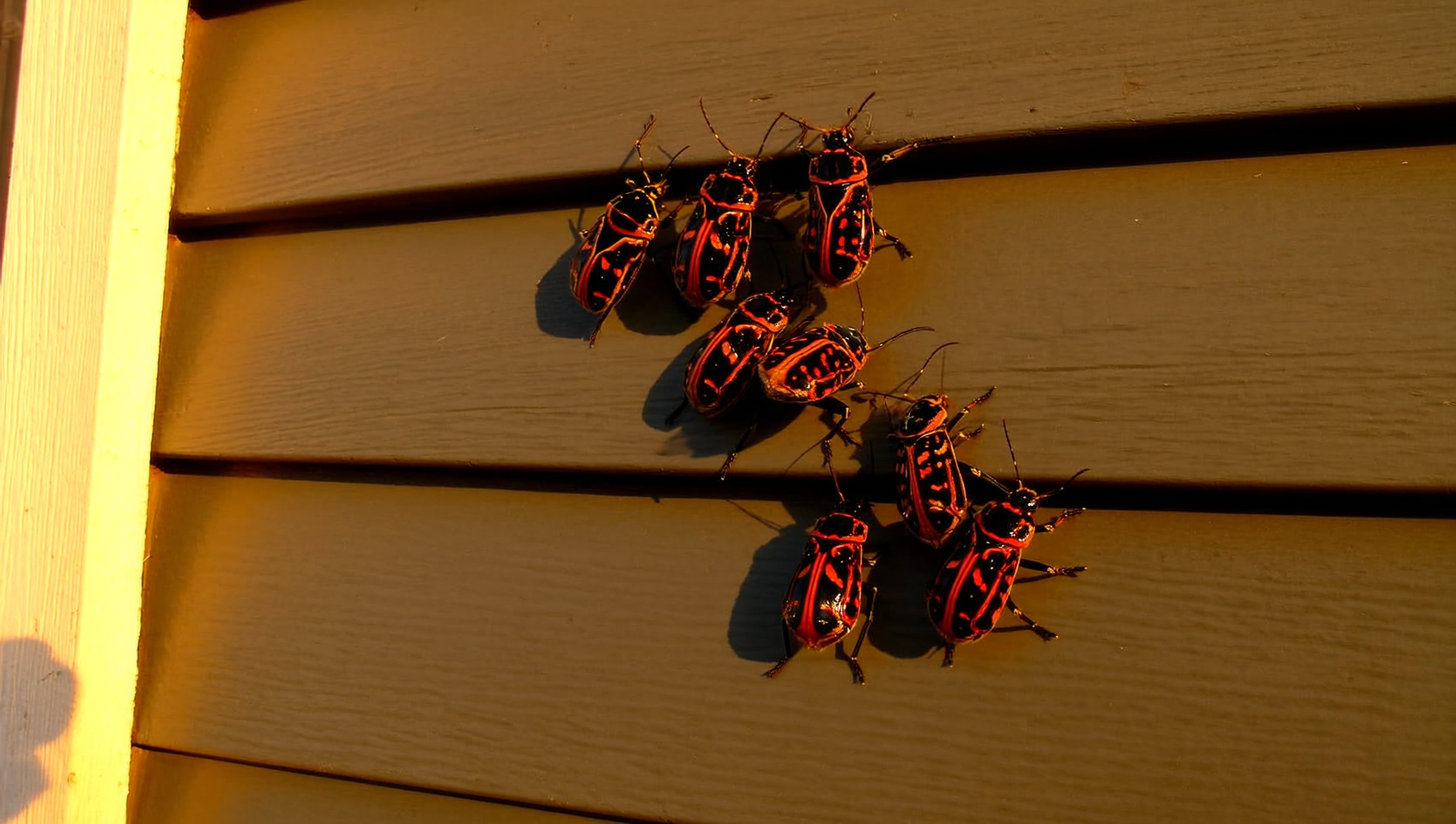
A boxelder bug is identified by four features: a black body about 0.5 inches long with three distinctive red or orange-red stripes (one along the center of the back and two along the outer edges of the wings); reddish-orange eyes; long thin antennae; and the behavior of congregating in large numbers on warm sunlit walls, particularly the south and southwest sides of buildings from late September through November.
What the adult looks like
- Body color: glossy black with three bright red or orange-red stripes, one along the center of the pronotum and two along the wing margins
- Body shape: elongated oval, flat back, about 0.5 inches (12mm) long
- Eyes: noticeably reddish-orange
- Antennae: long, segmented, dark
- Legs: dark, thin
- Wings: folded flat against the back when at rest; the X-pattern formed by the wing edges is often the field-ID marker visible at a distance
What the nymphs look like
- Body color: bright red with developing black markings
- Size: progressively larger from about 0.05 inches (1.5mm) at first instar to nearly adult size at fifth instar
- Behavior: clustered on host trees (boxelder maple, ash, or other maple species) through spring and summer; visible on tree trunks, seed pods, and the bases of host trees
Where the name comes from
The boxelder bug feeds primarily on the seeds of the female boxelder maple (Acer negundo), and to a lesser extent on ash and other maple species. The bug and the tree are biologically paired, most Treasure Valley boxelder bug populations are anchored to a female boxelder maple within a few hundred feet. Identifying the host tree is the single highest-leverage piece of information for long-term treatment.
Boxelder bugs cover south-facing Idaho walls every fall because they are seeking warm sunlit surfaces to bask on before overwintering. Treasure Valley’s combination of remaining warm October days, abundant host boxelder maples in older neighborhoods, and many homes with light-colored siding and stucco creates ideal aggregation conditions. The bugs cluster, mate, and then begin entering structures through small gaps in late October and early November to overwinter in warm protected spaces.
The fall invasion pattern
- September: populations on host trees peak; bugs begin aggregating in small groups on warm surfaces during the warmest part of the day
- Early October: aggregation accelerates, sunny 70°F+ October days produce the famous swarming-on-walls behavior; bugs cover south-facing siding, fence panels, and concrete walls
- Mid-October: mating peaks; first entry attempts into structures via foundation cracks, window frames, soffit gaps, and dryer vents
- Late October to early November: peak interior accumulation, bugs settle into wall voids, attics, garages, basements, and warm interior spaces to overwinter; this is when most Idaho residents notice them indoors
- November-February: bugs remain dormant in protected harborage; the occasional warm day will activate clusters and bring them into living areas
- March-April: overwintered adults emerge, head back to host trees, and the cycle restarts
The south-facing wall fixation
Boxelder bugs are heliotropic, they orient to sunlight and warmth. South-facing walls receive the most sunlight in fall and stay warmest into the afternoon, so that is where the aggregation behavior happens. Walls with light-colored siding or stucco reflect heat and become particularly attractive. Walls with cracked stucco, gaps in siding, or unsealed window/door frames become particularly problematic because the bugs are looking for both warmth and shelter.
Boxelder bugs inside a home are a nuisance, not a structural threat. They do not bite people or pets, do not transmit disease, do not damage wood or fabric, and do not reproduce indoors. They can stain light-colored surfaces with their reddish defensive secretion if crushed, and they produce a mild odor when disturbed. The damage from a boxelder bug invasion is the inconvenience of accumulation in walls, attics, and warm rooms, not material damage to the structure.
What they do
- Accumulate in wall voids and attics. Often in numbers visible at next year’s spring emergence.
- Stain light surfaces if crushed. Curtains, light-colored carpet, and painted walls are vulnerable.
- Emit a defensive odor when disturbed. Mild, fades quickly, similar to other true bugs.
- Wander into living spaces on warm winter days. Especially in rooms with consistent warmth (rooms with south-facing windows, rooms with woodstoves).
What they don’t do
- Don’t bite people or pets. Boxelder bugs do not have piercing-biting mouthparts capable of breaking human skin.
- Don’t transmit disease. No known role as a disease vector.
- Don’t damage wood or fabric. Not a structural pest. Not a fabric pest.
- Don’t reproduce indoors. They require host tree seeds; no breeding inside the structure.
The treatments that work for boxelder bugs are timing-sensitive exterior perimeter treatment, exclusion (sealing entry points), and host-tree-aware long-term planning. Reactive interior sprays do not work because the population is established outside before it ever enters; killing visible interior bugs does nothing about the hundreds in the wall void. The window of effectiveness for perimeter treatment is mid-September through early October, before the bugs begin entering the structure.
What works
- Mid-September exterior perimeter treatment. Applied before aggregation peaks. Targets the bugs while they are still on exterior walls and around the foundation. This is the single highest-leverage action.
- Sealing exterior entry points. Caulk around window and door frames, repair gaps in soffits, screen dryer and bath vents, seal utility penetrations, repair cracked stucco.
- Host tree management. If a female boxelder maple is within 200 feet of the home, removal or seed-pod management substantially reduces local population pressure. Discuss with an arborist if removal is on the table.
- Vacuuming visible interior bugs. Removes them without crushing (no stain risk). Empty the vacuum bag/canister immediately to prevent odor.
What doesn’t work
- Reactive interior aerosol spray on visible bugs. Catches the bugs you see, does nothing about the bugs in the walls.
- DIY repellent solutions on south-facing walls. Most consumer products fail to deter the aggregation behavior at the scale of an October swarm.
- Crushing bugs on light surfaces. Generates stains and odor without reducing the population.
- Ignoring the host tree. A neighbor’s female boxelder maple will reseed your aggregation every year regardless of how aggressively you treat your own walls.
Treatment: Boise → · Meridian → · Nampa → · Eagle →
Boxelder bug prevention is sealing the home before October and treating the perimeter in mid-September. The bugs find any gap that the warmth radiating from the structure leaks through; closing the gaps and treating the exterior surface together produces the substantial reduction. Treasure Valley homeowners who treat the perimeter in mid-September consistently see a 70-90% reduction in interior accumulation through the following winter.
Annual prevention actions
- Mid-September: schedule exterior perimeter treatment before aggregation peaks
- Late September: caulk gaps around windows, doors, and utility penetrations
- Throughout October: vacuum (do not crush) any visible interior bugs; empty canister immediately
- November-March: spot-vacuum interior emergers on warm days; check attics in late winter for wall-void emergence
- April: post-emergence exterior sweep to confirm overwintered population has departed
- Year-round: repair cracked stucco, replace damaged window screens, repair gaps in siding
- Boise general pest control →
- Meridian general pest control →
- Nampa general pest control →
- Eagle general pest control →
- Boxelder fall invasion guide (Learn) →
Wall covered in red-and-black bugs? Don’t crush them. Don’t wait for them to come inside. Call.
Idaho State Department of Agriculture (ISDA)-licensed Idaho applicator · Mid-September is the leverage window · Kid + pet safe once dry
Frequently Asked Questions
Q1: Are boxelder bugs in Idaho?
Yes. Boxelder bugs (Boisea trivittata) are common throughout the Treasure Valley including Boise, Meridian, Nampa, and Eagle. They are most visible from late September through November when they aggregate on south-facing walls in large numbers and begin entering homes to overwinter.
Q2: Why are boxelder bugs on my south-facing wall every fall?
Boxelder bugs aggregate on south-facing walls in fall because they orient to warmth and sunlight. South walls receive the most fall sunlight and retain heat longest into the afternoon, which makes them ideal basking surfaces before the bugs begin overwintering. Light-colored siding and stucco are particularly attractive because they reflect heat.
Q3: Do boxelder bugs bite or cause damage?
Boxelder bugs do not bite people or pets, do not transmit disease, and do not damage wood or fabric. They are a nuisance pest, not a structural pest. The only damage they cause is staining of light-colored surfaces if crushed, and a mild defensive odor when disturbed. They do not reproduce indoors.
Q4: How do you get rid of boxelder bugs in Idaho?
Boxelder bug control is timing-sensitive: schedule exterior perimeter treatment in mid-September before aggregation peaks, seal exterior entry points (window frames, soffits, vents, utility penetrations), and vacuum visible interior bugs without crushing. Reactive interior spray after the bugs are inside does not work, the leverage is exterior, in September, before they enter.
Q5: When is the best time to treat boxelder bugs?
Mid-September is the best time to treat boxelder bugs in Idaho. Aggregation begins in late September and entry into structures begins in mid-October; perimeter treatment applied before the population starts moving produces the substantial reduction. Treatment in November after bugs are already inside walls is less effective by a wide margin.