
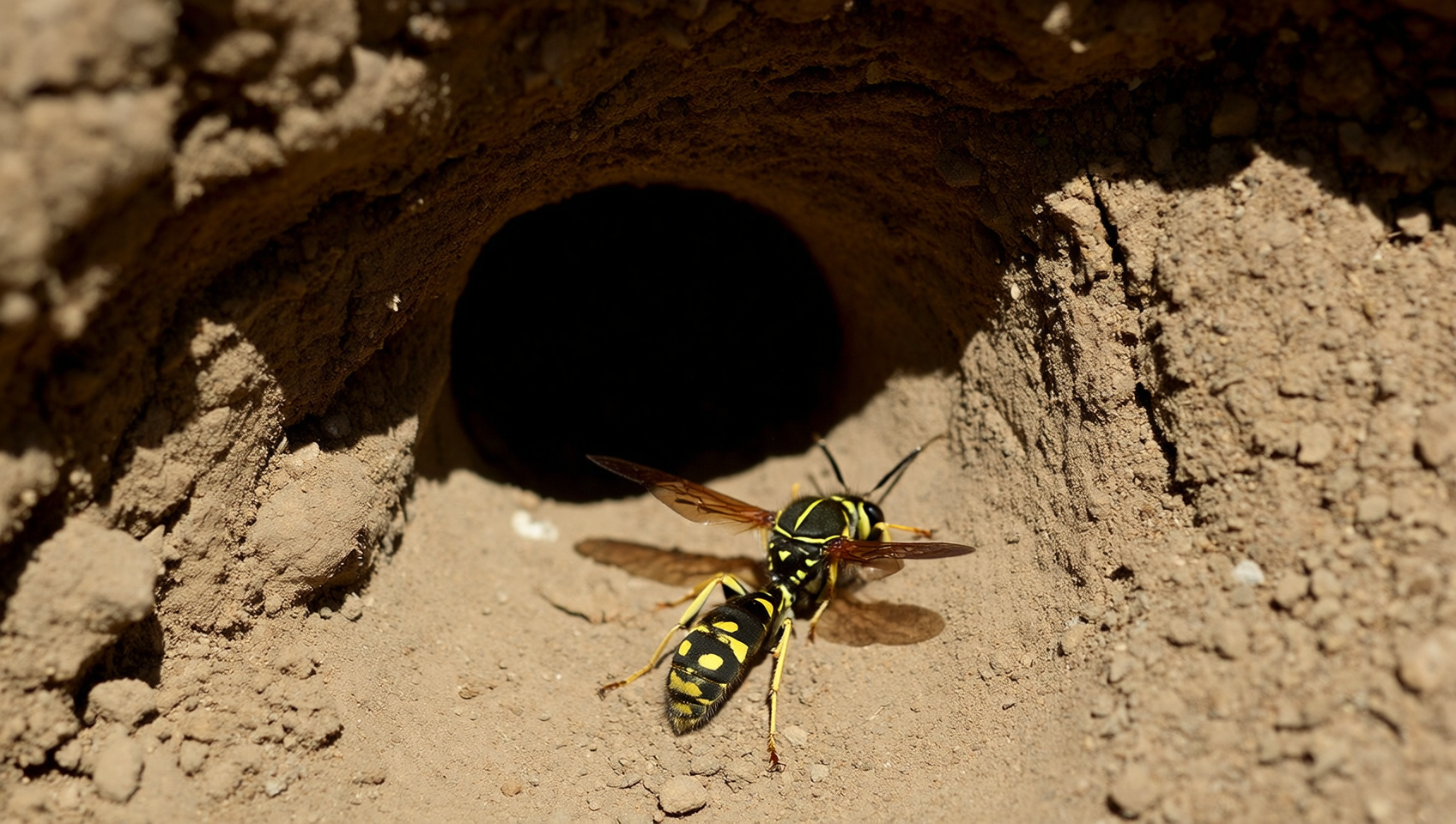
SPECIES · IDAHO · STINGING INSECTS · NEST IDENTIFICATION MATTERS
Wasps in Idaho, yellowjackets, paper wasps, and bald-faced hornets. Three different species. Three different nests. Three different treatment approaches.
The three stinging-insect species Treasure Valley homeowners most often confront are the western yellowjacket (Vespula pensylvanica), the paper wasp (Polistes aurifer and related Polistes species), and the bald-faced hornet (Dolichovespula maculata). These look similar at a glance but build different nests, aggregate in different sizes, and require different treatment approaches. Identifying the nest is the single most important field-ID step, yellowjackets nest underground or in wall voids with hundreds to thousands of workers, paper wasps build small open umbrella-shaped nests with dozens of workers, bald-faced hornets build large enclosed paper basketball-sized nests in trees with hundreds of workers. Treatment approach and risk level vary substantially by species.
Western yellowjackets are short, stocky, bright yellow-and-black, with a fast aggressive flight pattern and a tendency to nest underground or in structural voids. Paper wasps are longer, slender, with thin dangling legs in flight, brown or red-brown with yellow markings, and build small open hexagonal-cell nests under eaves. Bald-faced hornets are large, mostly black with bold white markings on the face and body, and build large enclosed paper nests the size of a basketball or larger, usually high in a tree.
Western yellowjacket (Vespula pensylvanica)
- Body color: bright yellow with bold black bands
- Body shape: short, stocky, legs tucked tight to body in flight
- Size: about 1/2 inch
- Aggression level: high, particularly in late summer and around food sources
- Nest: underground in old rodent burrows, in wall voids, occasionally in sheds and attics; nest is large papery comb arrangement enclosed in a soil cavity or wall void; colony size 500-5000+
- Visibility: nest is rarely visible, the only signs are workers flying in and out of a small ground hole, soffit gap, or siding crack
Paper wasp (Polistes aurifer + related)
- Body color: brown, red-brown, or red-and-yellow with darker bands
- Body shape: long and slender, with thin legs that dangle in flight
- Size: about 3/4 to 1 inch (larger than yellowjacket)
- Aggression level: moderate, defensive only of the nest
- Nest: small open umbrella-shaped paper comb (no enclosure) hanging from a thin stalk, usually under eaves, deck overhangs, swing-set frames, gazebo rafters; colony size 20-100 workers
- Visibility: nest is visible, open hexagonal cells with the wasps on top
Bald-faced hornet (Dolichovespula maculata)
- Body color: mostly black with bold white markings on face, thorax, and tip of abdomen, distinctive
- Body shape: stocky, larger than yellowjacket
- Size: about 3/4 inch
- Aggression level: very high near the nest; the most defensive of the three species
- Nest: large enclosed gray paper nest, basketball-sized or larger, hanging from a tree branch, shrub, or occasionally a building eave; colony size 100-700 workers
- Visibility: nest is highly visible once you know what you’re looking at, but often missed in dense tree canopy until late summer when the population peaks
Identifying the nest is the single highest-leverage diagnostic step. Yellowjacket nests are typically invisible, only the entry/exit traffic at a ground hole, soffit gap, or wall crack reveals the colony. Paper wasp nests are open umbrella combs hanging from a stalk under eaves or deck overhangs. Bald-faced hornet nests are large enclosed gray paper nests the size of a basketball or larger, usually high in a tree. The nest type determines the safe treatment approach.
Yellowjacket nest signs (often invisible)
- Ground-nest: a small (quarter-sized) hole in turf or mulch with steady worker traffic flying in and out, especially mid-morning and afternoon
- Wall-void nest: workers entering and exiting through a soffit gap, siding crack, vent screen tear, or gap around a utility penetration
- Attic or wall-void nest: sometimes audible, a steady soft humming sound from inside a wall on a hot day
- No visible papery comb unless excavated, the comb is fully enclosed
Paper wasp nest signs
- Open umbrella-shaped paper comb hanging from a thin stalk
- Hexagonal cells visible, open, no enclosing envelope
- Adults clustered on top of comb facing outward
- Typical locations: under eaves, in deck rafters, inside open garages, under porch ceilings, on swing-set frames, in gazebo and pergola rafters
- Nest stays small through summer (rarely larger than a tennis ball)
Bald-faced hornet nest signs
- Large enclosed gray paper nest, smooth exterior, basketball-sized or larger by late summer
- Single entrance hole at the bottom of the nest
- Typical locations: high in trees, in shrubs, occasionally on building eaves or under deck framing
- Often missed until August-September when the population peaks and worker activity becomes visible
DIY removal of stinging-insect nests is appropriate only for small (<6 inch) paper wasp nests on accessible eaves treated at dusk when activity is lowest. Yellowjacket ground or wall-void nests and bald-faced hornet nests require professional treatment, the colony size, aggression, and nest concealment make DIY removal a high-risk decision. Wasp nests near doors, walkways, play areas, or in wall voids should always be professionally treated regardless of species.
When DIY may be appropriate
- Small paper wasp nest (<6 inches across, fewer than 20 visible wasps)
- Accessible location that can be approached safely (no ladder beyond standard reach)
- At dusk or after dark when foraging workers are home and activity is lowest
- Person treating has no known stinging-insect allergy
- Treatment plan: a properly-rated wasp-and-hornet aerosol spray applied from a safe distance, allowing the colony to die overnight, then removing the empty nest the following day
When to call a professional immediately
- Any yellowjacket nest, ground or wall void
- Any bald-faced hornet nest, colony size and aggression make DIY high-risk
- Any wall-void nest of any species, chemical introduced into a wall void without follow-through can drive surviving workers into the living space
- Any nest near doors, walkways, play areas, or HVAC intakes
- Any large paper wasp nest (>6 inches) or one in a tight space (under deck framing, inside a vent housing)
- Anyone in the household has a known stinging-insect allergy, even small wasp nests warrant professional removal
What never to do
- Don’t pour gasoline or boiling water down a yellowjacket ground hole. Fire risk plus the inevitability of stings to the person attempting it. The hole goes deeper than you think, and the survivors come out angry.
- Don’t try to remove a bald-faced hornet nest at any size. Even small nests defend in numbers and at distance, bald-faced hornets are documented to chase intruders 30-50 feet.
- Don’t seal a wall-void wasp entry hole during the day when foragers are still outside. Sealing traps survivors who chew through interior drywall into living space. Treat first, then seal after no activity for 5-7 days.
Western yellowjacket aggression peaks in August and September because the colony’s food supply changes. Through summer the workers feed on protein (other insects); in late summer the queen stops laying and the colony shifts to scavenging carbohydrates from human food and sweet drinks. This is when yellowjackets become the wasps that hover over backyard barbecues, picnics, and outdoor garbage. Colony populations are at their peak (often 2000-5000+ workers), and the aggression around food sources is much higher than earlier in the season.
What changes August-October
- Food shift: workers move from insect protein to scavenged carbohydrates and sugars
- Population peak: colonies reach maximum size; ground nests can have 5000+ workers
- Aggression spike: workers defending food sources sting more readily than workers defending nest only
- Visibility: suddenly noticed at outdoor meals, around fruit trees, around garbage cans, in soda cans
- Nest still hidden: the colony is still typically underground or in a wall void, the visible wasps trace back to a hidden nest
This is why the September perimeter treatment is the highest-leverage timing for yellowjacket suppression on a Treasure Valley property, knock the colony before peak aggression, and the rest of the fall stays manageable.
Treatment: Boise → · Meridian → · Nampa → · Eagle →
Wasp prevention is exclusion plus food management plus an early-summer nest inspection. Repair gaps in soffits, siding, and screens before queens establish in May; remove small early paper wasp nests in May-June before colonies grow; manage exterior food and garbage to reduce yellowjacket attraction; and schedule professional treatment for any ground or wall-void colony before late-summer aggression peaks.
Annual prevention actions
- May: inspect eaves, deck rafters, soffit gaps, vents, and shed corners for early paper wasp queens establishing single-cell starter nests; remove starter nests before colonies grow
- June-July: monitor for ground-hole yellowjacket entry traffic; schedule professional treatment as soon as a ground or wall-void nest is identified
- August-September: yellowjacket aggression peak, keep exterior food/drinks covered, secure garbage, schedule professional perimeter treatment if not already done
- October-November: colonies die naturally with first hard frost (except bald-faced hornet nests, which collapse but remain visible); empty nests can be removed and entry points sealed
- Year-round: repair gaps and screen tears that admit foundress queens in spring
The Idaho pest calendar →
Are wasps active in Idaho winter →
- Boise wasp removal →
- Meridian wasp removal →
- Nampa wasp removal →
- Eagle wasp removal →
- Are wasps active in Idaho winter? (Learn) →
Ground hole with traffic? Basketball-sized nest in a tree? Don’t DIY. Call.
Idaho State Department of Agriculture (ISDA)-licensed Idaho applicator · Same-day removal where possible · 100% satisfaction warranty
Frequently Asked Questions
Q1: What kinds of wasps are in Idaho?
The three stinging-insect species Treasure Valley homeowners most often encounter are the western yellowjacket (Vespula pensylvanica), the paper wasp (Polistes aurifer and related species), and the bald-faced hornet (Dolichovespula maculata). Yellowjackets nest underground or in wall voids in colonies of 500-5000+ workers. Paper wasps build small open umbrella-shaped nests under eaves with 20-100 workers. Bald-faced hornets build large enclosed paper nests in trees with 100-700 workers.
Q2: How do you tell a yellowjacket from a paper wasp?
Yellowjackets are short and stocky, bright yellow and black, with legs tucked tight to the body in flight, and nest underground or in wall voids in large colonies. Paper wasps are long and slender, brown or red-brown with yellow markings, with thin legs that dangle in flight, and build small open umbrella-shaped nests under eaves with much smaller colonies. Body shape in flight and nest location are the easiest field-ID markers.
Q3: How do you identify a bald-faced hornet nest?
A bald-faced hornet nest is a large enclosed gray paper nest, smooth on the outside, basketball-sized or larger by late summer, hanging from a tree branch, shrub, or occasionally a building eave. It has a single entrance hole at the bottom. The hornets themselves are mostly black with bold white markings on the face and body. Bald-faced hornet nests should always be removed by a professional, the colony defends aggressively and at distance.
Q4: Why are yellowjackets so much worse in late summer?
Western yellowjacket aggression peaks in August and September because the colony’s food supply changes. Through summer workers feed on protein from other insects; in late summer they shift to scavenging carbohydrates and sugars from human food, sweet drinks, and garbage. Colony populations are also at peak (often 2000-5000+ workers). The visible wasps at backyard meals are foragers from a typically hidden ground or wall-void nest.
Q5: Should I remove a wasp nest myself or call a professional?
Small paper wasp nests under 6 inches on accessible eaves can sometimes be DIY-treated at dusk with a properly-rated wasp aerosol. Yellowjacket ground or wall-void nests, bald-faced hornet nests, any nest near doors or play areas, any nest in a wall void, and any large nest should be professionally treated. Sealing a wall-void wasp entry during the day traps survivors who can chew through drywall into living space, treat first, seal later.
Further reading on wasps in Idaho
- U.S. EPA — Safer Pest Control — integrated-pest-management positioning + label-compliance reference.
- CDC NIOSH — Insects and Scorpions (workplace safety) — sting/anaphylaxis preparedness, particularly relevant for outdoor work crews.
- University of Idaho Extension — Insects — Idaho-specific paper wasp / yellowjacket / bald-faced hornet identification.
- Oregon State University Extension — species-difference reference (the Treasure Valley’s species set is identical).