EAGLE, ID · ADA COUNTY · ISDA-LICENSED
Wasp, hornet & yellowjacket removal in Eagle.
Foothills retaining walls. Stucco eaves. Treated at dusk.
Boise Bug Bombers removes active wasp, hornet, and yellowjacket nests across Eagle, from the foothills retaining walls in Eagle Foothills and Castlebury to the stucco-eaved newer construction in Banbury Meadows and Two Rivers, using species-identified treatment by Hillard McMorris, an Idaho State Department of Agriculture (ISDA)-licensed Idaho applicator (#96328). Active aggressive nests are typically scheduled within 24 to 72 hours. Products are USDA-approved and kid- and pet-safe once dry.
In Eagle, ID 83616, the three stinging insects that put homeowners on the phone are yellowjackets (in foothills retaining walls and dry-stack rock terracing, heavy in Eagle Foothills, Lexington Hills, and the upper Castlebury elevation), paper wasps (under deep stucco eaves in newer Banbury Meadows and Two Rivers construction), and baldfaced hornets (large aerial nests in mature trees, more common around the older Country Club area and along the Boise River corridor where cottonwood density is highest). The treatment plan differs per species, and the foothills terrain adds a unique yellowjacket pattern that does not appear in flat Treasure Valley addresses.
2A. Yellowjackets in Eagle Foothills’ retaining walls
The hillside terracing across Eagle Foothills, Lexington Hills, and the upper elevations of Castlebury and Reflection Ridge, dry-stack rock, mortared block, and engineered concrete retaining walls, is reliable yellowjacket nesting infrastructure. The gap-rich, sun-warmed rock matches exactly what a ground-nesting yellowjacket queen wants in May, and the colony scales through summer. By July and August the entrance traffic is high enough that the homeowner steps near it and gets stung. Treatment is dust injection at the entrance at dusk, with a 48-hour follow-up confirmation.
2B. Paper wasps under newer Eagle stucco eaves
Banbury Meadows, Two Rivers, and the newer Country Club construction run heavy to stucco exteriors with deep eave overhangs. Paper wasps nest reliably under those soffits each May through August. Treatment hits the active nest at dusk (when the colony is on the paper), then follows up with a residual band along the eave junction so returning foragers do not rebuild in the same spot the next month.
2C. Baldfaced hornets along the Boise River corridor
The Boise River corridor through Eagle, the Greenbelt extension, Eagle Island State Park edge properties, and the older Country Club area, carries the cottonwood and willow density that baldfaced hornets favor for the football-sized aerial nests they build at 15-25 feet. We do not knock down what we can not safely reach, but for nests within ladder range, removal happens at dusk with the nest bagged and removed, not left to drop.
What we treat
In Eagle, ID 83616, the three stinging insects that put homeowners on the phone are yellowjackets (in foothills retaining walls and dry-stack rock terracing, heavy in Eagle Foothills, Lexington Hills, and the upper Castlebury elevation), paper wasps (under deep stucco eaves in newer Banbury Meadows and Two Rivers construction), and baldfaced hornets (large aerial nests in mature trees, more common around the older Country Club area and along the Boise River corridor where cottonwood density is highest). The treatment plan differs per species, and the foothills terrain adds a unique yellowjacket pattern that does not appear in flat Treasure Valley addresses.
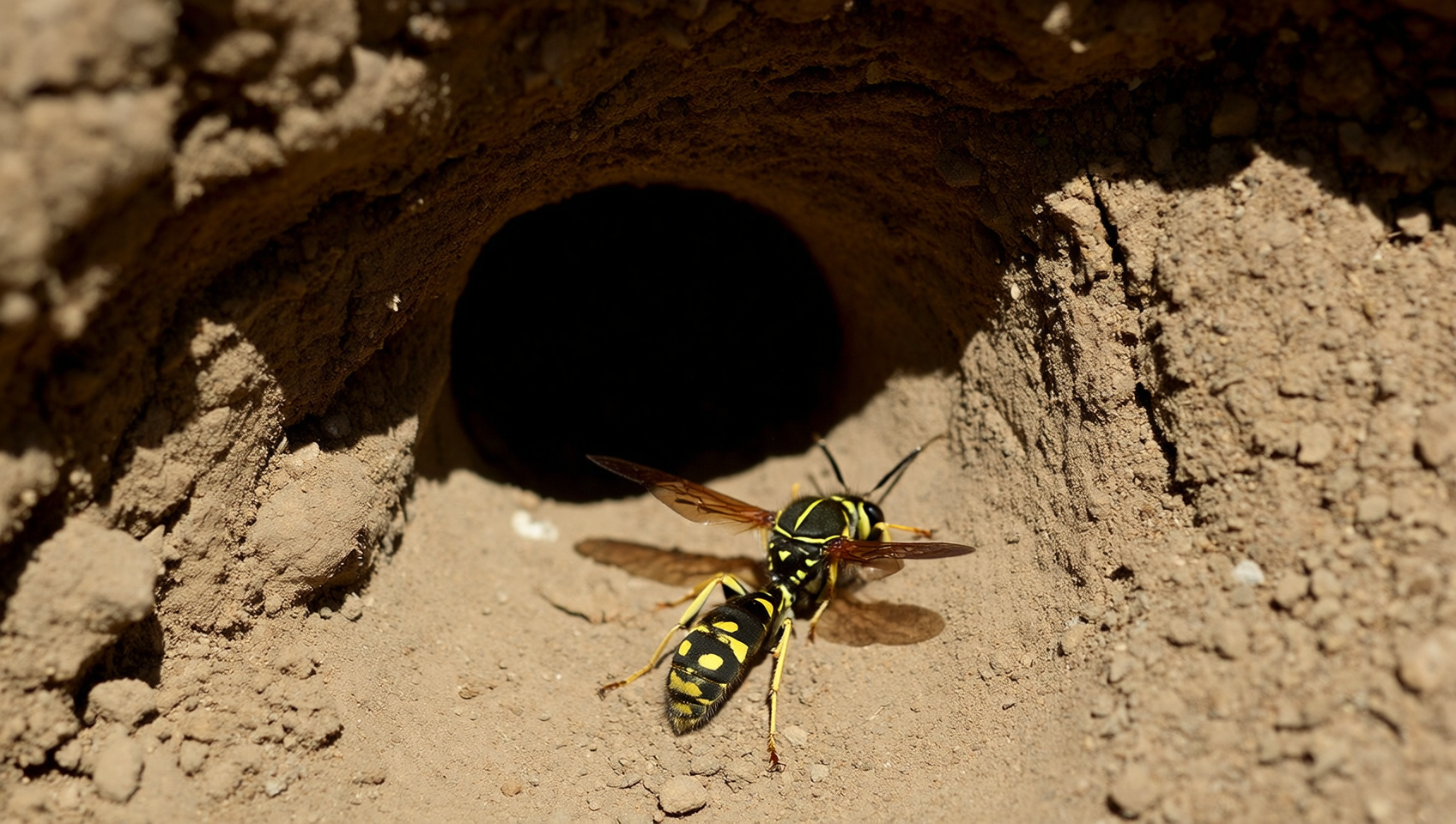
Yellowjackets in Eagle Foothills’ retaining walls
The hillside terracing across Eagle Foothills, Lexington Hills, and the upper elevations of Castlebury and Reflection Ridge, dry-stack rock, mortared block, and engineered concrete retaining walls, is reliable yellowjacket nesting infrastructure. The gap-rich, sun-warmed rock matches exactly what a ground-nesting yellowjacket queen wants in May, and the colony scales through summer. By July and August the entrance traffic is high enough that the homeowner steps near it and gets stung. Treatment is dust injection at the entrance at dusk, with a 48-hour follow-up confirmation.
Paper wasps under newer Eagle stucco eaves
Banbury Meadows, Two Rivers, and the newer Country Club construction run heavy to stucco exteriors with deep eave overhangs. Paper wasps nest reliably under those soffits each May through August. Treatment hits the active nest at dusk (when the colony is on the paper), then follows up with a residual band along the eave junction so returning foragers do not rebuild in the same spot the next month.
aldfaced hornets along the Boise River corridor
The Boise River corridor through Eagle, the Greenbelt extension, Eagle Island State Park edge properties, and the older Country Club area, carries the cottonwood and willow density that baldfaced hornets favor for the football-sized aerial nests they build at 15-25 feet. We do not knock down what we can not safely reach, but for nests within ladder range, removal happens at dusk with the nest bagged and removed, not left to drop.
Step 1, Species ID before approach. Yellowjacket, paper wasp, baldfaced hornet, and mud dauber are four different jobs. Treatment timing and product choice differ. Hillard identifies the species before approaching the nest.
Step 2, Foothills-specific access assessment. Eagle Foothills addresses frequently mean steep approach, terraced landscaping, and walls that require either ladder positioning around irrigation or treatment from above. Walkthrough confirms safe positioning before treatment begins.
Step 3, Dusk timing. Active nest treatment happens at dusk or dawn, colony is on the paper, foragers are home, treatment efficacy is highest. Daytime treatment risks aggressive return-flights without clearing the colony.
Step 4, Targeted treatment. Dust at retaining-wall ground entrances, aerosol on accessible paper-wasp nests, injectable for wall-void colonies in stucco eaves. Product choice depends on species and access, not on a one-spray-fits-all standard.
Step 5, Documentation + retreat. Treatment plan emailed after the visit. Active nest jobs include a 14-day re-inspection. Quarterly customers get free retreats between sprays if a new nest appears.
How it works
-
Species ID before approach
Yellowjacket, paper wasp, baldfaced hornet, and mud dauber are four different jobs. Treatment timing and product choice differ. Hillard identifies the species before approaching the nest.
-
Foothills-specific access assessment
Eagle Foothills addresses frequently mean steep approach, terraced landscaping, and walls that require either ladder positioning around irrigation or treatment from above. Walkthrough confirms safe positioning before treatment begins.
-
Dusk timing
Active nest treatment happens at dusk or dawn, colony is on the paper, foragers are home, treatment efficacy is highest. Daytime treatment risks aggressive return-flights without clearing the colony.
-
Targeted treatment
Dust at retaining-wall ground entrances, aerosol on accessible paper-wasp nests, injectable for wall-void colonies in stucco eaves. Product choice depends on species and access, not on a one-spray-fits-all standard.
-
Documentation + retreat
Treatment plan emailed after the visit. Active nest jobs include a 14-day re-inspection. Quarterly customers get free retreats between sprays if a new nest appears.
Wasp removal in Eagle costs $125 to $295 for a single active nest depending on species and accessibility, with foothills retaining-wall yellowjacket treatment frequently landing in the upper half of that range because of access complexity. Quarterly pest plan customers pay $40 to $80 per visit and get wasp removal included when a nest appears between scheduled sprays.
| Service | Price range |
|---|---|
| Single active wasp nest removal | $125-$295 |
| Yellowjacket retaining-wall treatment (foothills) | $175-$325 |
| Baldfaced hornet aerial nest (ladder-reachable) | $175-$325 |
| Preventive eave-band treatment | $75-$150 add-on |
| Quarterly pest plan (wasp included) | $40-$80 per visit |
Same Eagle quote on the phone as at the door.
Pricing
Wasp removal in Eagle costs $125 to $295 for a single active nest depending on species and accessibility, with foothills retaining-wall yellowjacket treatment frequently landing in the upper half of that range because of access complexity. Quarterly pest plan customers pay $40 to $80 per visit and get wasp removal included when a nest appears between scheduled sprays.
| Service | Price range |
|---|---|
| Single active wasp nest removal | $125-$295 |
| Yellowjacket retaining-wall treatment (foothills) | $175-$325 |
| Baldfaced hornet aerial nest (ladder-reachable) | $175-$325 |
| Preventive eave-band treatment | $75-$150 add-on |
| Most popular Quarterly pest plan (wasp included) | $40-$80 per visit |
Same Eagle quote on the phone as at the door.
Boise Bug Bombers serves all of Eagle, ID 83616, covering Banbury Meadows, Eagle Foothills, Two Rivers, Country Club, Lexington Hills, Castlebury, Reflection Ridge, the area around Eagle Rock Reservoir, the BanBury Golf Course corridor, the Eagle Island State Park edge, and the Boise River foothills frontage. Average drive time from the shop at 1650 N Hilton St in Boise to an Eagle address is 20 to 30 minutes; active aggressive nests are typically scheduled within 24 to 72 hours.
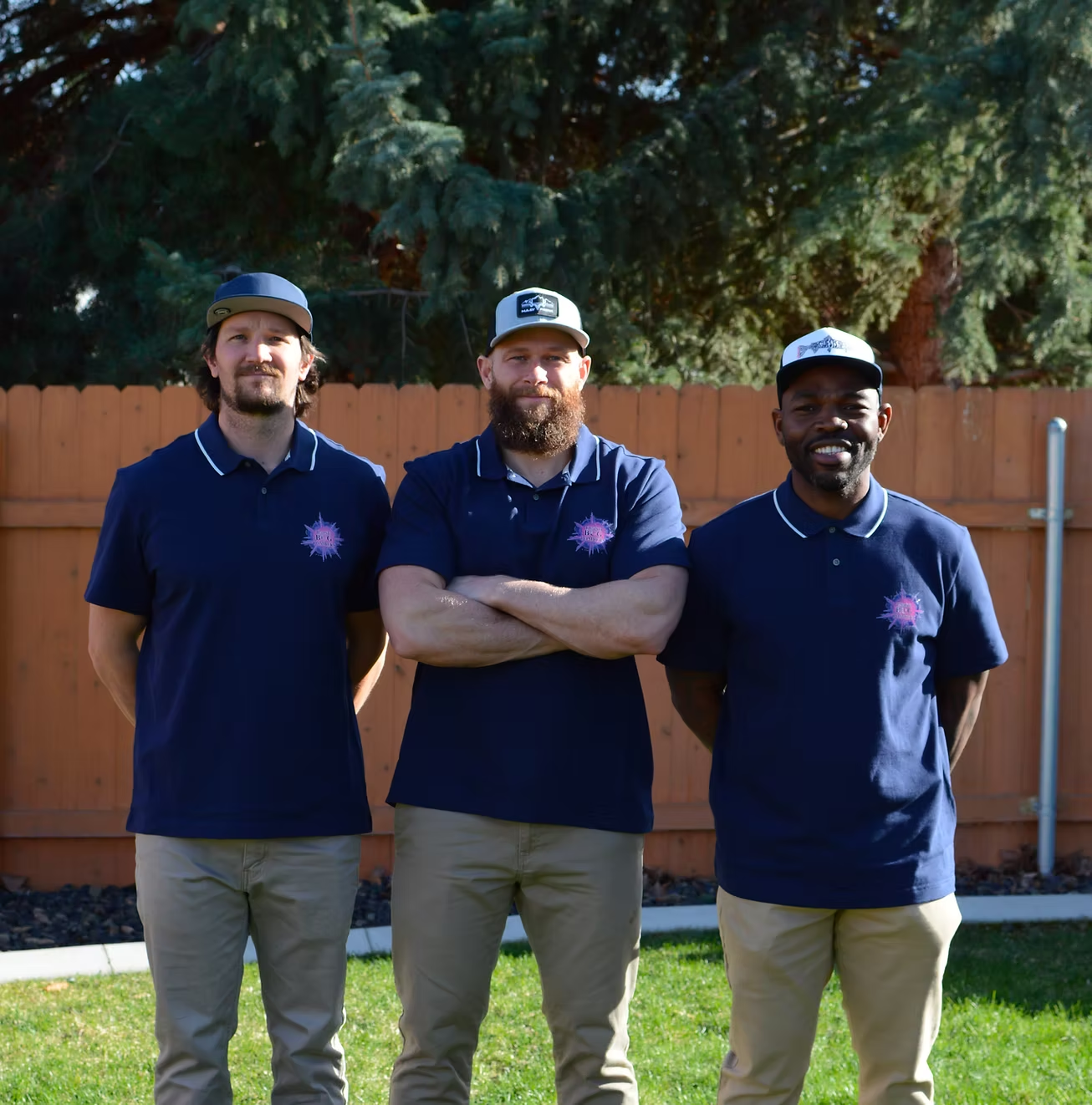
Hillard McMorris leads the team in Eagle. Idaho State Department of Agriculture (ISDA)-licensed Idaho applicator (#96328), the person who answers (208) 918-2597. Foothills retaining-wall yellowjacket jobs reward the technician who has done one before, entrance dusting at the wrong angle gets a homeowner stung the next afternoon. From Kirsten Aura’s Google review: “Hillard and his team are definitely the solution to your pest problem.”
→ /about/
Get an Eagle wasp appointment this week.
24-72 hour Eagle wasp response · 100% satisfaction warranty · Idaho-licensed
Bringing peace and happiness by spreading death and destruction… to your pests.
Q1: Does Boise Bug Bombers remove wasp nests in Eagle, Idaho?
Yes. Boise Bug Bombers removes paper wasp, yellowjacket, and baldfaced hornet nests across Eagle, ID 83616, including Banbury Meadows, Eagle Foothills, Two Rivers, Country Club, Lexington Hills, and Castlebury. Average drive time from the shop at 1650 N Hilton St in Boise to an Eagle address is 20 to 30 minutes, and active aggressive nests are typically scheduled within 24 to 72 hours.
Q2: Why are yellowjackets in my Eagle Foothills retaining wall?
Eagle Foothills retaining walls, dry-stack rock, mortared block, engineered concrete terracing, provide ideal yellowjacket nesting infrastructure. The gap-rich, sun-warmed rock matches what a ground-nesting queen wants in May, and the colony scales through summer. By July and August, entrance traffic is high enough that homeowners step near it and get stung. Dust treatment at the entrance at dusk is the effective response.
Q3: How much does wasp removal cost in Eagle?
Wasp nest removal in Eagle costs $125 to $295 for a single active nest, with foothills retaining-wall yellowjacket treatment frequently landing in the $175 to $325 range because of access complexity. Baldfaced hornet aerial nests run $175 to $325 when ladder-reachable. Quarterly pest plan customers pay $40 to $80 per visit and get wasp removal included.
Q4: When is the best time to treat a wasp nest in Eagle?
The best time to treat an active wasp nest in Eagle is at dusk or dawn, when the colony is on the paper and foragers are home. Daytime treatment risks aggressive return-flights without clearing the colony. Boise Bug Bombers schedules active wasp treatments at dusk for this reason.
Q5: Can Boise Bug Bombers come to Eagle for an emergency wasp nest?
Active aggressive nests in Eagle are scheduled within 24 to 72 hours. Phone (208) 918-2597 directly to Hillard for fastest scheduling. Nest removal happens at dusk for safety and efficacy; the nest is bagged and removed where ladder-reachable, not left to drop.
- Eagle Foothills
- Banbury Meadows, 2B, 5
- Two Rivers, 2B, 5
- Country Club, 2B, 2C, 5
- Lexington Hills, 2A, 5
- Castlebury, 2A, 5
- Reflection Ridge, 2A, 5
- Eagle Rock Reservoir, 5
- BanBury Golf Course corridor, 5
- Eagle Island State Park edge, 2C, 5
- Boise River corridor / cottonwood + willow, 2C
- ZIP code 83616
- 1650 N Hilton St → Eagle drive time
Hyperlocal anchors woven into treatment-relevant geography, foothills retaining walls map to yellowjackets, stucco eaves in newer subdivisions map to paper wasps, Boise River cottonwood corridor maps to baldfaced hornets. Not template fill, actual species-by-terrain mapping.
Sources
Authoritative references for wasp removal in Eagle and the broader Treasure Valley. All third-party links open in a new tab.
- EPA: Wasp + Hornet Pesticide Products
- CDC NIOSH: Insect Sting First Aid + Anaphylaxis
- University of Idaho Extension: Yellowjacket Biology
- Idaho Poison Center: Sting Reaction Hotline 1-800-222-1222
- Penn State Entomology: Paper Wasp Identification
- Ada County Idaho: Local Government Resources
Q6: How quickly can you schedule wasp removal in Eagle?
Boise Bug Bombers offers same-week scheduling for wasp removal across Eagle and the broader Treasure Valley. Most Eagle appointments are booked within 2-4 business days. Emergency calls (active wasp nests, post-bite black widow situations) get same-day scheduling whenever possible. Call (208) 918-2597 for next-available.
Q7: What does wasp removal cost in Eagle, Idaho?
Wasp removal in Eagle typically runs $40 to $80 per visit on a quarterly plan or $175 to $295 for a one-time treatment depending on home size and pest pressure. Boise Bug Bombers quotes upfront on the phone with no surprise add-ons. Phone quote matches the door quote.
Q8: Are your wasp removal products safe for kids and pets in Eagle?
Yes. Boise Bug Bombers uses USDA-approved residual products that are kid- and pet-safe once dry. Drying time is typically 1 to 2 hours after application in Eagle. ISDA-licensed applicator Hillard McMorris reviews any per-product re-entry recommendations at the appointment.